Two-time Oscar winner Gene Hackman, 95, and his wife, classical pianist Betsy Arakawa, 64, and their dog were found dead Wednesday afternoon in their home outside Santa Fe, New Mexico, the Santa Fe County Sheriff’s Office says.
In an email to CBS News early Thursday, the office said, “Foul play is not suspected as a factor in those deaths at this time. However, (the) exact cause of death has not been determined.”
“This is an active and ongoing investigation by the Santa Fe County Sheriff’s Office,” the statement added.
MARK J. TERRILL / AP
Hackman was a consummate actor renowned for playing complicated figures in such classics as “The French Connection,” “The Conversation” and “Unforgiven,” and who also delighted superhero fans as the comical villain Lex Luthor in three “Superman” films.
Hailed as one of the best actors of the era before retiring from the screen in 2004, Hackman moved easily among genres, from heart-wrenching family stories (“I Never Sang for My Father”), crime dramas (“Bonnie and Clyde,” “Mississippi Burning”), thrillers (“The Conversation,” “No Way Out”), and triumphant tales of sports (“Hoosiers”) to comedies (“Get Shorty,” “The Royal Tenenbaums”).
Rough-hewn and flinty, a movie star without stereotypical movie-star looks, Hackman gave even his humorous roles a slightly sinister, unpredictable edge.
The quality of Hackman’s performances and the charisma that the shy ex-Marine would bring to the screen were praised by famed stage director Ulu Grosbard, who’d once hired him for a small role in Arthur Miller’s “A View from the Bridge.” In a 2004 Vanity Fair profile, Grosbard described the actor as “a complex guy. Very intelligent. A generosity of spirit. Socially charming. A lot going on in him. A certain sense of being tormented with past ghosts and things. That’s part of what he brings to his work.”
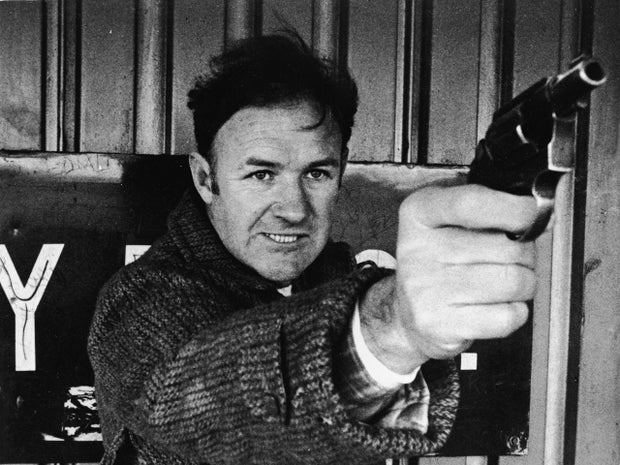
“Ghosts and things” were likely evoked in three of Hackman’s most heralded performances, in movies that redefined their genres. In William Friedkin’s “The French Connection” (1971), Hackman played “Popeye” Doyle, a New York City detective unbound by rules, who constantly crossed the line between law officer and law breaker while tracking down the head of a drug ring. Dangerous and unpredictable, his Doyle was brash, vindictive and colorful, whether it was chasing down a suspect while wearing a Santa Claus costume or recklessly driving a car in pursuit of an assassin through the streets of Brooklyn.
20th Century Fox / Getty Images
In Francis Ford Coppola’s “The Conversation” (1974), he starred as Harry Caul, a surveillance expert whose wiretapping of his subjects leads to increased paranoia about his own safety when he believes he’s uncovered evidence of a murder plot; and in Clint Eastwood’s revisionist Western “Unforgiven” (1992), Hackman played “Little” Bill Daggett, the brutal sheriff of a Wyoming town who confronts Eastwood’s bounty-hunting gunslinger.
In a 2001 New York Times interview, Hackman noted that his scene in which he brutally beats up a bounty hunter played by Richard Harris was fueled by the disappointment that Harris hadn’t remembered working with Hackman on the 1966 film “Hawaii.”
“I just took that disappointment and did this kind of transference,” Hackman said.
Hackman was less “method-y” than some of his peers, though he admitted that the ways in which he would behave on-screen and off as he inhabited a character — fueled by memories of his dysfunctional family growing up and the slights he faced during his struggling early years — took their toll. Temper tantrums earned him a nickname: “Vesuvius.”
”I don’t mean to live my roles,” he told The Times. ”But sometimes I suppose it’s not comfortable to be around me.”
His success as an actor was merely one facet of Hackman’s biography. He also raced sports cars, flew planes, deep-sea dived, painted, designed houses, and wrote or co-authored adventure and historical novels — living a life as varied and challenging as the roles for which he became famous. “I need the diversity,” he explained to CBS’s “Sunday Morning” in 2000.
“One could say, you know, that I’ve achieved some manner of success,” Hackman said. “But it’s like the difference between being a doctor and a lawyer, and being, maybe, a laborer. I feel that, in some ways, my efforts of being an actor are so all-instinctive, and that I haven’t really paid my dues in terms of my contribution to the firmament.”
Robert R. McElroy / Getty Images